Every project is led by a licensed GC who coordinates all trade sequences and carries full liability coverage.
All work is executed to current building code, with documentation prepared for municipal inspection and insurance claim review.
We source finish materials that match your original specifications, from paint sheen to trim profiles to flooring grain patterns.
We handle permit applications, schedule required inspections, and deliver a complete permit-close documentation package when work is done.
Fire affects every layer of a building. Our licensed trade teams address each system in the correct sequence, from the structure out to the finished surface.
Heat-compromised lumber, burned joists, and weakened subfloor panels are removed and replaced with code-grade materials. All new framing is installed to current span and load specifications.
Learn moreFire-affected drywall is fully removed, not patched. New panels are hung, taped, and finished to a level that passes visual inspection and matches existing wall texture.
Learn moreFire-damaged wiring is never spliced or partially replaced. All affected circuits are fully replaced with new wire runs, updated panels, and code-compliant devices by licensed electricians.
Learn moreHeat causes PVC and copper supply lines to fail without visible signs of damage. We replace all plumbing within fire-affected zones and perform pressure testing before closing walls.
Learn moreFire distorts door frames and window openings. We reframe openings to square and level, install new units to manufacturer specifications, and seal to current energy code requirements.
Learn moreThe final phase covers trim carpentry, cabinetry, flooring, and paint. We use spectrophotometer color matching to achieve results that blend seamlessly with unaffected areas of your home.
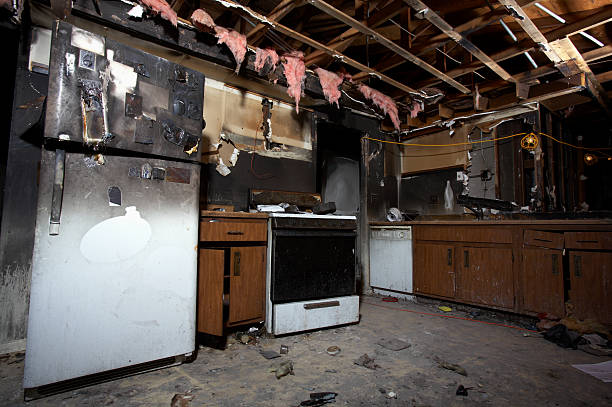
Learn moreWhen fire moves through a structure, it does not damage materials uniformly. The visible char on a wall surface tells only part of the story. What matters for long-term structural integrity, code compliance, and insurance settlement is what happened inside the wall assembly, beneath the floor, and within the electrical and mechanical systems that run through the framing. Addressing fire damage correctly requires a licensed general contractor who understands construction sequencing and can coordinate multiple licensed trade crews working in the right order. Skipping steps, reversing the sequence, or relying on cosmetic repairs over proper replacement are the three most common mistakes made in fire damage work, and they are all expensive to undo later.
Wood begins to lose structural capacity at temperatures that are well below full ignition. At approximately 150 degrees Fahrenheit, wood begins to dry out and the moisture content drops in ways that accelerate future burning and reduce load-bearing capacity. At 250 degrees, the material undergoes pyrolysis, a chemical change that permanently alters the cellular structure of the wood even if no visible charring occurs. By 300 degrees, strength values drop measurably. This matters because structural framing adjacent to a fire zone may show no visible burn damage and still be carrying significantly reduced load capacity. Proper fire damage assessment includes moisture meter readings, probe testing for subsurface char depth, and in some cases laboratory analysis of framing members before any determination is made about what stays and what is replaced. Our structural assessments follow these standards, not a visual inspection alone.
The National Electrical Code and most local building departments in Washington, DC require that all wiring within a fire-affected area be replaced, not extended or spliced. The reason is well-established: heat causes the plastic insulation surrounding wire runs to become brittle, crack, and in some cases melt in ways not visible after the fire cools. A wire that appears intact may have lost its rated insulation resistance. When that wire is re-energized, the failure mode is a short circuit, an arc fault, or a smoldering ignition inside a wall cavity. Our electricians pull complete wire runs from the panel to each device location, install new junction boxes, and apply arc-fault circuit interrupter (AFCI) protection where required by current code. Permit-required electrical inspections are scheduled before any walls are closed.
Most jurisdictions in Washington, DC require building permits for fire damage repair work that involves structural members, electrical systems, plumbing, or mechanical equipment. Permit applications require scope-of-work documentation, contractor license numbers, and in many cases engineered drawings for structural repairs. The benefit of permitted work is not merely legal compliance. Permitted repairs are inspected by a municipal building official, which means the completed work carries an official record of code compliance. For insurance purposes, this documentation supports the claim settlement and prevents disputes about whether the repairs were done to standard. We handle the permit application process, coordinate inspection scheduling, and deliver the closed-permit documentation to you and your insurance carrier at the end of the project.
Insurance carriers require that repairs return a home to its pre-loss condition, which means finish materials must match the original specifications. This is more complex than it sounds. Paint colors from a decade ago may be discontinued. Flooring products may have changed manufacturing tolerances. Trim profiles may no longer be available in standard sizes. Our estimating team documents the original materials before demolition begins, sources matching products through specialty suppliers when standard channels come up short, and provides insurance carriers with itemized material specifications that support full replacement value claims. We do not substitute down-grade materials because they are easier to source. The work is done to match.
Fire damage repair follows a strict sequence: structural work is completed and inspected before any systems work begins, and all systems work is completed and inspected before finish work begins. Installing drywall before the electrical rough-in inspection means tearing it out again. Finishing floors before the plumbing pressure test risks water damage to new flooring. Our project managers schedule each trade phase with inspection hold points built in, so the project advances only after each phase is verified. This adds some calendar time compared to an uncoordinated approach, but it eliminates the costly rework that occurs when the sequence is ignored. Code-compliant fire damage repair is not faster if corners are cut. It is done correctly once.
Four structured phases ensure nothing is missed and every repair meets code.
Our licensed GC walks the structure to document all affected systems. We assess structural members, electrical zones, plumbing lines, and finish surfaces and deliver a written scope of work.
We file permit applications with the local jurisdiction, identify and source all specification-matched finish materials, and schedule subcontractors in the correct trade sequence.
Structure first, systems second, finish third. Each phase is completed and inspected before the next begins. Our project manager is on site at each phase transition.
We schedule the final municipal inspection, walk through the completed work with you, and deliver your full permit-close package and warranty documentation.
After the fire in our kitchen, I was overwhelmed by the scope of what needed to happen. The crew explained the trade sequence to me step by step and kept me informed at every phase. The electrical and drywall work passed inspection the first time.
The material matching on my flooring and trim was impressive. I was worried the repaired areas would look different from the rest of the house, but you genuinely cannot tell where the damage was. The craftsmanship met the standard I needed for my insurance claim.
They handled the permit process entirely and delivered the closed-permit documentation to my insurance adjuster before I even had to ask. Having that official record of code-compliant repairs resolved my settlement faster than I expected.
Call our licensed repair team in Washington, DC today for a thorough damage assessment and a permit-ready scope of work.
+1-866-484-1409