If your home was cleaned after a fire but the smoke smell keeps coming back, your odor was masked, not eliminated. We treat the chemistry behind the odor using hydroxyl radical technology, thermal fogging, and full HVAC pathway decontamination.
Volatile organic compounds (VOCs) penetrate porous materials at a molecular level. Air fresheners cannot reach them. Paint cannot seal them permanently. Proper treatment requires neutralizing the odor molecule bonds inside the material itself.
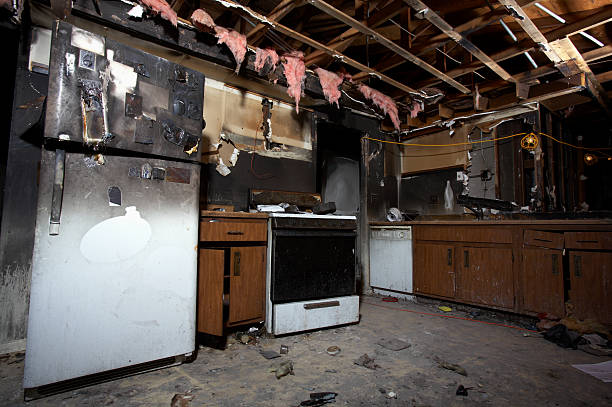
We neutralize odor compounds at the molecular level using hydroxyl radical oxidation technology, not fragrance-based masking products.
Odor-laden air recirculates through your ductwork with every HVAC cycle. We decontaminate the full duct pathway to prevent re-contamination.
Our technicians are trained in hydroxyl radical generation equipment, the same technology used in commercial and industrial air remediation.
When treatment is complete, we verify air quality with post-treatment testing. We do not consider the job done until the odor is gone.
Effective odor elimination requires treating the odor where it lives: in the porous surfaces, the air pathways, and the building systems that continuously recirculate contaminated air.
We use air quality meters and odor concentration testing to identify where VOC levels are highest, map the penetration depth in affected materials, and build a treatment plan specific to your structure.
Learn moreThermal fogging converts a deodorizing solution into particles small enough to follow the same paths smoke traveled, penetrating wall cavities, subfloor spaces, and ceiling voids that surface treatments cannot reach.
Learn moreHydroxyl radical generators produce OH radicals that oxidize volatile organic compounds and odor molecules on contact. Unlike ozone treatment, this process is safe for occupied spaces and treated areas.
Learn moreWe treat the full duct system including the air handler, return air pathways, and supply runs. Untreated ducts will re-contaminate a cleaned structure every time the HVAC system operates.
Learn moreIn cases where VOC penetration depth is too great for oxidation treatment alone, we apply encapsulant coating technology to lock residual odor compounds within the material substrate and prevent off-gassing.
Learn moreAfter all treatments are complete, we conduct air sampling and VOC concentration measurements to verify that odor compound levels have returned to normal baseline. You receive documentation of the results.
Learn moreIf you have had your home professionally cleaned after a fire and the smoke smell has returned weeks or months later, you experienced what is technically called odor re-emission. The cleaning products used masked the odor temporarily, the freshness wore off, and the underlying odor compounds began off-gassing again. This is not a failure of effort. It is a failure of method. Understanding why odor re-emission happens requires understanding how smoke compounds behave at a chemical level and what that means for treatment.
Combustion produces hundreds of volatile organic compounds (VOCs), including formaldehyde, acrolein, benzene, and a range of polycyclic aromatic hydrocarbons. These compounds are carried by smoke as gas-phase molecules, which means they are small enough to travel into the microscopic pores of porous materials including wood framing, drywall paper facing, insulation batts, fabric upholstery, carpet padding, and the wood fibers inside cabinet and trim millwork. Once inside a porous material, VOC molecules bond to the surface through adsorption, a process where molecules adhere to the internal surface area of the material structure. The internal surface area of porous building materials is vastly larger than the visible exterior surface, which is why a wall can look and feel clean while holding a significant odor load inside the material itself.
The bond strength of adsorbed VOCs varies by compound and by material. Some molecules desorb and off-gas relatively quickly when air circulation changes. Others remain adsorbed for months, releasing slowly as temperature and humidity fluctuate. This is the chemistry behind the pattern where smoke smell seems to diminish after thorough cleaning, then returns during warm weather or when the HVAC system activates. The heat and humidity shifts are causing adsorbed compounds to release from the material surface back into the air.
Air fresheners, scented candles, odor-neutralizing sprays, and even professional-grade deodorizing products work by introducing fragrance compounds into the air that override the odor signal at the olfactory level. They do not chemically alter the odor molecules bonded inside porous materials. This distinction is the entire reason why masking approaches fail over time. The fragrance dissipates. The underlying VOC load does not. A surface that has been sprayed with a deodorizing product still holds the same adsorbed odor compound mass it held before treatment, and it will continue releasing those compounds until they are either chemically neutralized or physically sealed in.
Encapsulant coating technology approaches the problem differently. A penetrating encapsulant is applied to the affected material surface and driven into the pore structure of the substrate. As it cures, it forms a polymer matrix around the adsorbed odor compounds, sealing them within the material and preventing further off-gassing. This is not a topcoat that can be scraped off or repainted over. A properly applied encapsulant is an integral part of the material surface. The chemistry behind effective encapsulants involves bonding to both the substrate and the adsorbed compound, creating a barrier that resists temperature-driven desorption. Encapsulant treatment is used when odor penetration depth is too great for oxidative treatments to reach, or as a final step after oxidation to lock in any remaining residual compounds.
Both ozone and hydroxyl radical treatment work through oxidative chemistry, meaning they destroy odor compounds by chemically altering their molecular structure rather than masking them. The critical differences are safety and application range. Ozone treatment requires complete evacuation of the treatment area for the duration of the process, typically 24 to 48 hours for a severely affected structure, because ozone at treatment concentrations is hazardous to breathe and damaging to rubber, plastics, and some fabrics. Ozone treatment is fast and highly effective on surface-accessible compounds, but its rapid reactivity means it tends to exhaust before penetrating deeply into porous materials.
Hydroxyl radical treatment generates OH radicals through UV light interaction with water vapor, producing a molecule that reacts with VOCs on contact but is produced continuously over the treatment period rather than all at once. This allows hydroxyl radical treatment to remain active for days, reaching compounds that are slowly diffusing out of porous materials as treatment continues. The process is safe for occupied spaces, meaning pets, plants, and sensitive electronics can remain in the treated area. For residential structures with significant smoke penetration into framing and insulation, hydroxyl radical treatment is generally the preferred primary treatment method because of the combination of safety, penetrating capability, and extended action time.
A thermal fogger heats a deodorizing solution to produce extremely fine particles in the range of 0.5 to 15 microns in diameter. Particles this small behave more like gas than liquid, meaning they are carried by air currents into the same cavities, gaps, and pathways that smoke traveled during the fire. This includes wall cavities behind intact drywall, subfloor spaces, attic framing bays, and the interior surfaces of HVAC ducts. The fogging agent contacts the adsorbed odor compounds inside these concealed spaces and undergoes a deodorizing reaction. This is why thermal fogging is a core component of professional odor elimination treatment for smoke-affected structures: it is the delivery mechanism that gets the treatment chemistry to where the odor actually lives.
The HVAC system in a fire-affected home is one of the most important and most frequently overlooked odor sources. Smoke is drawn through the return air intakes and carried throughout the duct system during and after the fire event. The internal duct surfaces, the air handler components, and the filter media all accumulate odor compounds. Every time the HVAC system cycles, conditioned air passes through this contaminated system and picks up odor compounds before being distributed through the supply registers. This is why a room that appears fully cleaned can still smell of smoke when the heat or air conditioning turns on. Odor removal treatment must include a complete HVAC odor pathway assessment and treatment to prevent re-contamination from the distribution system.
Four science-based phases that address odor at every depth, from air pathways to porous substrate bonds.
We use air quality meters to measure VOC concentrations throughout the structure, identify the highest-load areas, and map penetration depth in affected materials to determine the appropriate treatment protocol.
Before treating the structure, we address the HVAC distribution system. Ducts, the air handler, and return air pathways are treated to eliminate the primary re-contamination source.
We apply the appropriate primary treatment, hydroxyl radical generation for occupied-safe extended treatment, or thermal fogging for cavity penetration, followed by encapsulant application where indicated.
After treatment is complete and the treatment period has elapsed, we measure VOC concentrations again and compare to baseline readings. Documentation of results is provided for insurance and personal records.
We had two previous companies come out after our kitchen fire, and the smoke smell kept returning within a few weeks. After the hydroxyl treatment here, it has been months with no return. They explained the VOC chemistry to me clearly and I understood exactly why the previous attempts had not worked.
The HVAC pathway treatment was something no one else had mentioned to me. Every time my AC turned on I could smell the smoke. After the duct treatment and the thermal fogging, the system runs clean. The post-treatment air quality report was a great deliverable for my insurance carrier.
The team tested the air quality before and after treatment and showed me the actual VOC readings on a printout. Having that documentation gave me confidence the treatment had worked, not just the temporary impression from fresh product smell. I refer everyone here who asks about odor problems.
Contact our Odor Removal team in Wrightstown, NJ for an odor concentration assessment and a treatment plan that addresses the chemistry, not just the surface.
+1-866-484-1409